Be our guest! Tuscany & Umbria; Italian Riviera & Cinque Terre; Capri, Positano & Amalfi Coast; Venice; Rome; Dingle, Ireland; St Lucia; Santorini, Greece; America Southwest & national parks!
Request a custom itinerary!
Read about our destinations!!!
Italian Riviera & the Cinque Terre
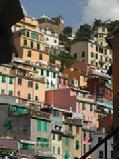
The Cinque Terre Five miles of rocky coast in eastern Liguria, two promontories lie at each extremity, thousands of kilometres of dry walling, cultivated into vineyards, five southerly villages castled up on spurs of stone or disposed in clusters of very small inlets. These are the co-ordinates of the Cinque Terre (Five lands) and the villages of Riomaggiore, Manarola, Corniglia, Vernazza and Monterosso. The area is now a National Park and since 1997 a UNESCO protected territory as a system of naturalistic environmental interest. This zone is characterized by the presence of precipitous slopes which have been cultivated into vineyards by means of fatiguing system of terracing the only evidence of transformation operated by the laborious human activity on the territory. The suggestive type of coastal projections on the sea with sheer cliffs that often overtake the verticality alternated with bays, winding paths and enchanting small beaches between cliffs with a profound back drop, a rich variety of ichthyic (fishing) all of which make this district an authentic natural "opera of art".
Portofino, Rapallo & Santa Margherita Ligure Rapallo is one of the largest municipalities on the Eastern Riviera and is resort town with an expanse of glass-fronted restaurants and plush hotels around a south-facing bay. It lies sheltered from winds and currents in an inlet on the Golfo del Tigullio: this beautiful temperate spot was already inhabited in pre-Roman times by the Tigulli of Liguria. Under Genoese dominion from 1229 to 1797, the castle overlooking the sea that can still be visited today was built there in 1550 for defense against numerous incursions. In the early part of the twentieth century it was a backwater, and writers in particular came for the bay's extraordinary beauty, of which you now get an inkling only early in the morning or at dusk. Max Beerbohm lived in Rapallo for the second half of his life, and attracted a literary circle to the town; Ezra Pound wrote the first thirty of his Cantos here between 1925 and 1930, D.H. Lawrence stayed for a while and Hemingway also dropped by (but came away muttering that the sea was flat and boring). The resort's striking landmarks are the large marina and the castle, now converted into an exhibition space, stuck out at the end of a small causeway. Unlike most of the Tigullio resorts, Rapallo does have an existence independent of its tourist trade, particularly around the old town, a grid of cobbled streets behind the stone Saline Gate: this is the commercial centre and venue for the Tuesday fish and vegetable market, while the busy Thursday market at Piazza Cile to the northwest of the centre beneath the train tracks is a good place to buy cheap clothing. Cubeletti" are typical jam pastries made in Rapallo. Lace-making also has a long tradition here, and seventeenth-century Villa Tigullio houses a local lace museum. The Rapallo tourist office is at Via Armanda Diaz 9 (Mon–Sat 9am–12.30pm & 3.30–6.30pm, Sun 9.30am–12.30pm; tel 0185.230.346).http://www.comune.rapallo.ge.it/interna_AT.asp?id=210
Santa Margherita Lugure is situated in a small bay on the Golfo di Tigullio between Portofino and Rapallo. Santa Margherita was already quite developed in mediaeval times and not only inhabited by fishermen. In the seventeenth centurymany Genoese families began building their summer residences here: some of these are very impressive, such as Villa Durazzo Centurione, whose gardens are today open to the public. It was during the same period that the old parish church of Santa Margherita Vergine e Martire was built in the town centre. The other large church, the church of San Giacomo in Corte, was built in the following century, as was the Capuchin monastery. The older Oratory of Sant'Erasmo holds a collection of mariners' votary objects. Also worth visiting are the old parish churches at Nozarego and San Lorenzo della Costa. Along a fairly restricted length of coast, there is a large variety of beaches and scenery, ranging from the rocky coastline of San Michele di Pagana to the sandy bay of Paraggi. Santa Marghertita and area info: http://www.santamargheritaturismo.it/spip.php?rubrique36
To appreciate the exceptional beauty of Portofino you need to see it from the square in front of the church of San Giorgio on the lighthouse promontory: from this position you have a splendid overview of the port and the row of coloured houses with their typical decorations. Portofino lies in a bay whose natural shelter is provided both by its shape and by Monte Portofino itself, which looks over the sea from a height of 600 metres and forms a three-kilometre ridge ending to the east at Punta del Capo. This favourable natural position attracted very early human settlement, and we learn from Pliny that "Portus Delphini" was already known in Roman times. After being under the dominion of the Abbey of San Fruttuoso for almost two centuries, it was taken into the Republic of Genoa in the twelfth century. The Republic built a fortress there in the seventeenth century which is now known as Castello Brown, after the British Consul who bought it in 1870. The church of San Martino stands in the oldest part of the town and dates back to the twelfth century, while the Oratorio dell'Assunta was built in the fourteenth century. The tourist harbour can berth up to 300 boats and has hosted the most prestigious leisure craft in the world, since it attracts the most exclusive type of tourists. So many of the most famous names of twentieth-century history and art have visited Portofino that even a partial list of names would be difficult to draw up. http://www.comune.portofino.genova.it/index.asp
Capri, Positano & Amalfi Coast
Capri & Anacapri Only a mere 5 Km of sea separate Capri from Punta Campanella on the tip of Sorrento Peninsula. The 11 Km2 island supports a population of about 12,500, distributed between the two townships of Capri and Anacapri. The island is approx. 6 Km long and 3 Km wide and has a coastline of about 17 Km. The simple road network runs along the main axis between Capri and Anacapri with few side roads and can only be travelled by local residents; the island has just been declared a pedestrian zone, especially as a means of protecting the countryside. On the other hand, the narrow streets that thread their way through the island's towns are hardly suitable for traffic. The automobiles of non-residents are only allowed on the island off season. The highest point on the island is Monte Solaro (589 m.) and can be reached by chairlift or along a trail from Anacapri. Tje island's other important peaks are Monte Cappello (515 m.), Monte Tiberio (335 m.), Monte S. Maria (499 m.) and Monte Tuoro (262 m.). The rock mass is of a definite limestone composition (cretaceous rock), however Eocene rocks can also be observed. The volcanic eruptions of Mount Vesuvius and in the nearby Phlegrea region left deposition of tufa and ozzolana here. The island's vegetation is distinctly Mediterranean with a proliferation of 850 different species and 133 varieties of plants. The most popular form of wildlife on Capri is the seagull, however special mention is also due the rare blue lizard and the endangered monk seal. Charming local towns, extraordinary hospitality as well as excellent, well laid-out tourist facilities open the island's beautiful to its many visitors from all over the world. Capri's popularity with international tourist is due in good part to its rediscovery by some of the world's most famous writers. In addiction to its historic, literary and scenic wonders, Capri can be boast of excellent beaches, making it one of the world's leading swimming and climatic resorts. Capri is serviced daily from the mainland by a large number of ferries and hydrofoils. The Isle of Capri can be reached from Naples (Molo Beverello) by ferry in approx. 1 1/2 hrs. Hydrofoils make the trip in about 1/2 hr. (from Naples Mergellina, Via Caracciolo). Capri also has ship connections to Sorrento and, in season, to Positano, Amalfi and Ischia.
Capri Capri, main town on the Isle of Capri, is located on the saddle between Monte Santa Maria and Monte Tiberio in a commanding location above the two "Marinas", and offers an unparalled view that sweeps from Ischia to the Sorrento Peninsula, taking in the entire expanse of the Gulf of Naples. With its characteristic arcades that merge into a labyrinth of narrow alleys and streets, Capri works its own special charm on every visitor. The steps of the famous Piazzetta are an unofficial rendezvous for a colorful congregation of guests from all over the world, who take in the attractive view from here. The Parrocchiale di Santo Stefano (Parish Church of St. Stephan) was constructed in the 17th century on the ruins of an earlier cathedral and is well worth a visit. Works of art in the Baroque style are also found here, of which the multicolored marble floor in the Villa Jovis rates special mention. On a rise not far from Capri is Santa Maria del Soccorso with its beautiful panorama of the Sorrento Peninsula and the ruins of Villa Jovis, commonly known as the Palazzo di Tiberio (Palce of Tiberius), a typical example of Roman villas. Legend has it that Tiberius himself ruled the Roman Empire from this villa, and the entire area abounds with sagas and legends about the Roman Emperor. The "Salto di Tiberio" occupies a special place in the legends as a steep precipice, off which the Emperor's enemies were pushed. A short distance from Villa Jovis are the ruins of an old lighthouse, the Torre del Faro. The part of Capri known as Marina Grande is the island's most important harbor, fully equipped whit modern port facilities. Moreover, Marina Grande is a famous swimming and sunning resort. The cog railway makes the trip to Capri in four minutes. There is also a well paved road to Capri, along which are the Chiesa di San Costanzo (Church of St. Costanzo) from the 11th century and the Scala Fenicia (Phoenicians Stairs), climbing steeply to the castle Castello di Barbarossa. For centuries, these stairs were the only connection between Capri and Anacapri. Anacapri Second largest town on the island, is situated on a fertile plateau at the foot of Monte Solaro.It is a captivating vacation resort surrounded by Mediterranean country side of exceptional beauty. Monte Solaro, 589 m., an unforgettable lookout point, is reached from Anacapri by means of a chairlift or foot trail. Visible near the mountain station of the chairlift are the ruins of a fortress that was erected by the British in 1806 on the foundations of a medieval structure (Fortino di Bruto). Along the trail to Monte Solaro a road turns off at la Crocetta to shrine "Santuario Santa Maria a Centrella". This is also the vantage point for a magnificent view of Capri and the Sorrento coast. From Caprile do not fail to make a side trip to Belvedere della Migliara and to the lighthouse Faro di Punta Carena and enjoy the fantastic view once again. Along the road from Anacapri to Damecuta are the excavations of the last three villas from the days of Imperial Rome. In Damecuta itself, rich in archeological finds, a tour can be made to the tower Torre di Damecuta, that was erected in the Middle Ages to defend Capri's coasts against marauding pirates. From here, too, there is a splendid view of Ischia, Procida and the Gulf of Naples. Another point of interest reached from Anacapri is the world-famous Grotta Azzurra (Blue Grotto), undoubtedly one of the world's most famous beautiful limestone caves. The Blue Grotto is also accessible by boat from Marina Grande. The source of the Grotto's enduring fame is the strong reflection of color as well as the submerged remains of Roman walls, definite proof that the grotto was once above sea level. In a panoramic location on the left side of the road from Anacapri back to Capri is the Villa di San Michele, built by the Swedish doctor Axel Munthe on the ruins of a Roman villa near the Chapel of St. Michael.
Amalfi Coast Amalfi Coast is made of thirteen towns along the road that goes from the Gulf of Salerno to that of Naples. Creeks, coves and cliffs on the sea: the variegated landscape enchants all the visitors that come to these towns, Vietri sul mare, Cetara, Maiori, Minori, Ravello, Scala, Praiano, Atrani, Positano, Amalfi, Conca dei Marini, Furore and Tramonti. Each of these towns has its treasure made of lemons, villas, gardens, sea, beaches, smells. The landscape is made of sea and mountains, with creeks and coves often attainable only by sea, such as the wonderful cave, grotta dello Smeraldo in Conca dei Marini and Furore fiord. In some areas nature is completely uncontaminated. The area is occupied by Lattari Mountains, of calcareous nature: the highest mountain is Monte S. Angelo a Torre Pizzi (1425 m). The Coast is characterised by the typical cultivations on the terraced land where the most important product is lemon and other citruses. Lemons are mostly sweet; they can also be eaten in slices, as a dessert, with or without sugar. A legend tells that the inhabitants of Minori convinced the Pope to give them back the bishopric giving him as a present a basket with lemons and other citruses. Lemons are used for cakes and to make the "limoncello", a traditional yellow liqueur famous all over the world.
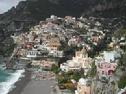
Positano On one of the most beautiful stretches of coastline in the province of Salerno, at the center of the gulf formed by Germano tip to the west and Cape Sottile to the east, on two mountain slopes, stands Positano, in a splendid panoramic position. Positano is one of the most interesting places on the Amalfi coast. The center of the town is enchanting: among the delightful white or pastel-colored houses, stands the parish church of Santa Maria Assunta, with its splendid majolica dome. Positano combines the beauty of its numerous beaches, with the fascination of its ancient fishing port and lanes crowded with quaint colorful shops. Positano is a “vertical” village. Houses are organized as a coloured cascade along the hills. They are built on the rocks and look towards the blue sea, the narrow streets and the clean and nice beaches. Positano is situated among three small valleys, in the middle between Punta Germano and Capo Sottile, at the feet of Lattari Mountains. In front of the coast there are three small isles, forming an archipelago, called “Li Galli” or “Sirenuse”: according to a legend mermaids lived there. The most beautiful church of Positano is the one dedicated to Our Lady of the Assumption, celebrated on 15th August.
Amalfi
On one of the most famous stretches of the coastline, in a splendid panoramic position, stands Amalfi, one of the most fascinating towns in the Campania region. The town preserves important evidence of its prestigious past: the cathedral, dedicated to St. Andrew, dominating the square of the same name from above steep steps, the Paradise cloister, a construction in Arabian-style dating to the thirteenth century and the ruins of the Arsenal of the Republic. The imposing nature of these buildings, the fascination of typically Mediterranean architecture, made up of mazy lanes and characteristic white houses piled one upon the other, the natural beauty of the place, make Amalfi one of the most famous Italian resorts.
Santorini
Santorini is one of the cycladic islands, created by the eruption of the volcano 1500 B.C. (thought by some to have brought about the end of the Minoan civilization and speculated by some as the famous island of Atlantis). Due to this, the island offers a versatile landscape with on the one hand steep darkish rock formations and on the other hand beaches and small white villages. Besides that, there are several interesting monuments and the active volcano of course. Thira offers, besides remnants from several eras, ruins of the old Roman baths, theatres and markets.
Santorini is a group of islands in a circle about 10 KM across - the rim of a large volcano that is still producing small islands in the center. Steep slopes lead to the central area and gentle slopes lead to the sea that circles the island. It's really a group of islands even though it is usually discussed as if it were one. Settlements are scattered around the island as a series of small villages.
The famous white buildings are huddled close to one another on and over the cliff of the central caldera. Hiking paths and trails lead all over the island, but a charming time can be had walking the paths that interconnect the settlements and exploring the shops. Visitors can take ferry boats to the central island(s) to visit the new land and soak in hot springs.
Venice
Venice is perhaps best described as "half fairy tale and half tourist trap," as noted by the novelist Thomas Mann. The city can fulfill many visitors' vision of it: a romantic place with quiet, winding streets and canals, and treasures like St. Mark's Square, the Peggy Guggenheim Collection, and the islands of Murano and Burano. With its unique location, below sea level and crisscrossed by a network of canals, Venice attracts visitors from all over the world throughout the year. Venice is by day a bustling city populaterd by pedestrians moving about the walkways and across the numerous bridges while all forms of boat traffic and water buses traverse the hundreds of waterways and the Grand Canal. History, architecture, culture, art, shopping and gerat food all combine to make this other-woldly place a truly memorable place to visit.
Dingle Penninsula in Southwest Ireland The dramatic beauty of the Dingle Peninsula has been an inspiration and a wonder to artists and visitors for hundreds of years. Once described by the National Geographic Traveler as “the most beautiful place on earth”, the Dingle Peninsula is a place of intense allure, with a plethora of green landscapes, rocky hills, long sandy beaches and staggering cliff edges. The warm Gulf Stream reaches the peninsula, giving has a wonderful mixture of sometimes rare and unusual flora and fauna. There is no other landscape in Western Europe with the density and variety of archaeological monuments as the Dingle Peninsula. This mountainous finger of land which juts into the Atlantic Ocean has supported various tribes and populations for almost 6,000 years. Because of the peninsula's remote location, and lack of specialized agriculture, there is a remarkable preservation of over 2,000 monuments. Dingle is one of Ireland’s Government-protected Irish (Gaelic)-speaking areas, called “Gaeltachts”. Dingle's Irish name is Daingean Uí Chúis which, to fit on signposts, is generally abbreviated to An Daingean. The Dingle Peninsula is also associated with the film industry. Ryan’s Daughter was filmed here, as were parts of Far and Away, which starred Tom Cruise .
St Lucia
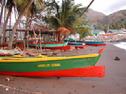
St. Lucia is a natural paradise offering wonderful scenery along with characteristic Carribean cultural flavor. The small island of St. Lucia resembles the islands of the South Pacific. St Lucia has a great variety of plant and animal life. Orchids and exotic plants grow wild in the rainforest while roadsides are covered with many tropical flowers. Colorful tropical birds abound, including endangered species like the indigenous St Lucia parrotas well as hummingbirds and the St. Lucia Oriole.
The twin Pitons are the island's majestic and distinctive ancient volcanic mountain landmarks. Steep coastlines, beaches of various shades of sands, fishing villages, antique plantation houses and remanants of long-forgotten sugar mills and the rainforest preserves of St. Lucia's mountainous interior offer one of the Caribbean's finest locales for painting in a moderate year-round climate. Areas of particular interest include Viex Fort & Laborie in the south, Praslin Bay & Dennery on the rugged east coast, and Soufriere, the Pitons and natural and scenic locations on the west coast.